If you are planning to buy a barcode label cutting machine in India, looking only at the purchase price can lead to the wrong decision. Different manufacturers offer different machine configurations, production speeds, automation levels, and finishing capabilities. As a result, two machines that look similar can have very different prices and production capabilities.
A modern label die cutting machine does more than cut labels. The right machine can improve production speed, cutting accuracy, material handling, waste management, and finished-roll quality.
This guide explains the major factors that affect barcode label die cutting machine price in India by RK Label Printing Machinery Private Limited - Unit-1(one) and helps label converters, printing companies, packaging businesses, and manufacturers make a better purchasing decision.
What Is the Price of a Barcode Label Die Cutting Machine in India?
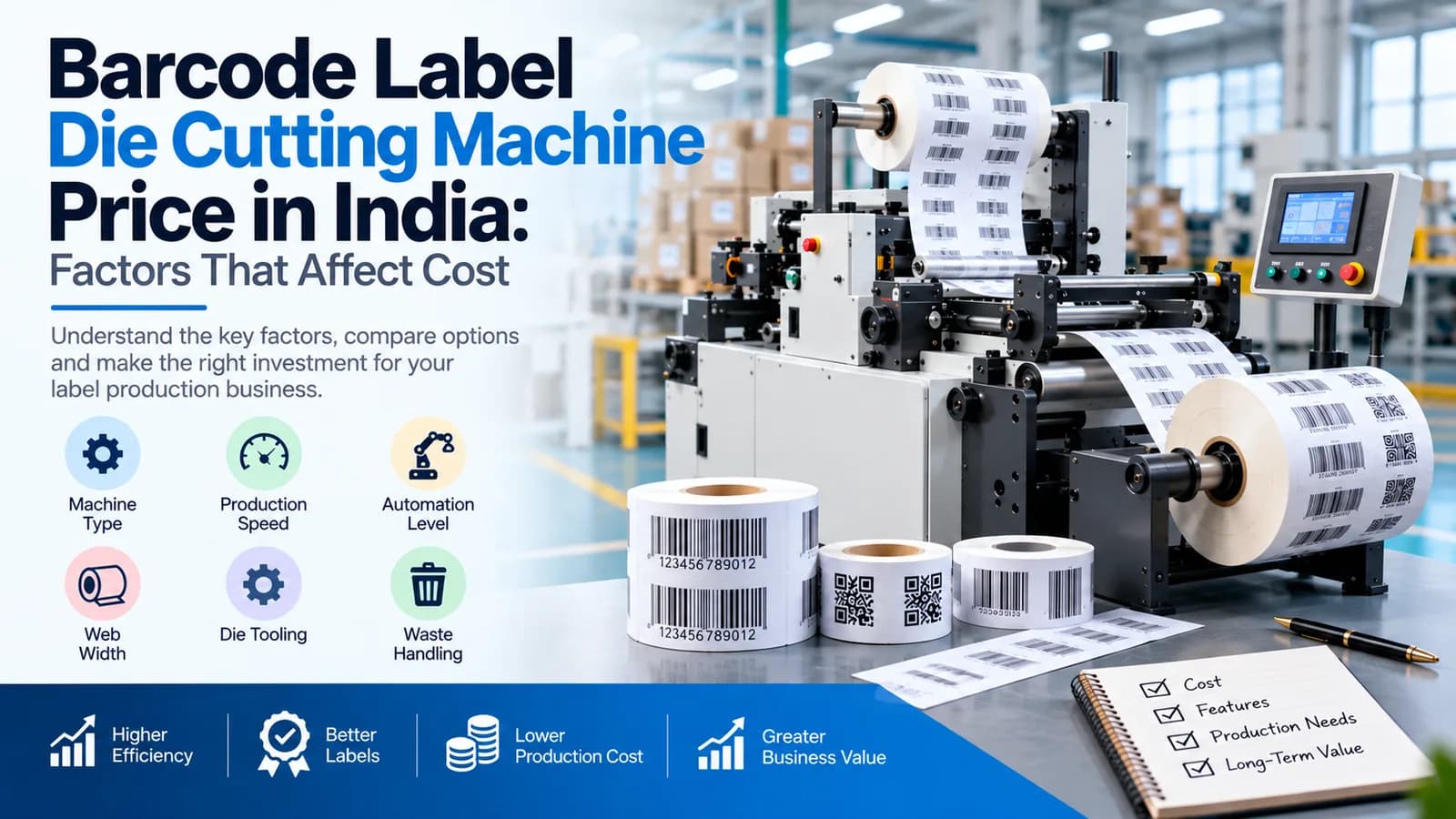
There is no single fixed price for a barcode label die cutting machine in India. The final cost depends on machine type, configuration, automation, speed, web width, tooling, and finishing requirements.
For example, current manufacturer listings show different configurations with starting prices around ₹7.5 lakh, ₹8.5 lakh, and ₹10.5 lakh, depending on the machine type and features. These prices can vary based on customization, GST, installation, tooling, transportation, and commercial terms. Buyers should always request a detailed quotation from the manufacturer before making a purchase.
Quick Answer
Barcode label die cutting machine prices in India depend mainly on cutting technology, production speed, automation, web width, die tooling, rewinding, waste handling, and machine configuration. The best machine is not necessarily the cheapest one; it is the machine that delivers the right production capacity and operating cost for your business.
Key Factors That Affect Barcode Label Die Cutting Machine Price
1. Machine Type
The cutting technology is one of the first factors that affects machine cost.
Depending on your application, you may find:
- Flatbed die cutting machines
- Rotary die cutting machines
- Semi-rotary die cutting machines
- Roll-to-roll die cutting machines
- Die cutting and sheet cutting machines
- Die cutting machines with slitting and rewinding
A basic roll-to-roll machine and a fully integrated finishing machine will not have the same price.
For example, RK Label's RK-3040-D roll-to-roll die cutting machine lists a maximum paper width of 320 mm and a production speed of 10,000–15,000 strokes per hour.
2. Production Speed
Production speed directly affects your potential output.
If your business produces small batches, you may not need the highest-speed machine available. However, high-volume label converters may benefit from a machine designed for continuous production.
Some high-speed configurations list production capabilities of 10,000–15,000 strokes per hour. Actual output can vary depending on label size, material, die design, job setup, and machine operating conditions.
Ask These Questions Before Choosing a Speed
- How many labels do you produce each day?
- What is your average label size?
- How many SKUs do you handle?
- How many shifts do you run?
- How many hours will the machine operate each day?
Do not select a machine only because it offers the highest maximum speed.
3. Level of Automation
Automation can significantly affect the price of a barcode label making machine.
Basic machines may require more manual adjustments. Advanced machines can include servo controls, automatic web guiding, electronic controls, touchscreen interfaces, and automated rewinding.
Automation can help with:
- Reducing manual intervention
- Improving repeatability
- Faster job setup
- Consistent production
- Lower operator dependency
- Better process control
For high-volume production, the additional investment in automation may deliver better productivity over time.
4. Servo Motor and Web Control
Servo-based feeding systems help control material movement and production accuracy.
Modern die cutting machines can use servo systems for paper pulling, registration, and web control. RK's 3040-S configuration, for example, lists servo paper pull and print-mark scanning features.
This can become particularly important when processing pre-printed barcode labels where accurate positioning matters.
5. Web Width
Maximum web width also affects machine pricing.
RK's 3040 series lists a maximum paper width of 320 mm.
If you mainly produce narrow barcode labels, purchasing an unnecessarily large machine can increase your capital investment.
However, wider web capability can be useful when you want to produce multiple labels across the web.
A Simple Calculation
Required Web Width = Number of Labels Across Web × Label Width + Gaps + Edge Margins
Use your actual label dimensions and production requirements when selecting the machine width.
6. Roll-to-Roll Capability
If your production workflow uses rolls, a roll-to-roll barcode label cutting machine can provide an efficient production setup.
The machine can feed material from a roll, perform die cutting, and rewind the processed material.
RK-3040-D is designed for roll-to-roll die cutting and lists online waste matrix rewinding as part of its configuration.
This type of workflow can reduce manual material handling and support continuous production.
7. Waste Matrix Rewinding
After die cutting, the material surrounding the labels becomes waste matrix.
An online waste matrix rewinding system can collect this waste during production rather than requiring extensive manual handling.
For high-volume label converters, this feature can provide practical production benefits.
It can also help keep the production area organized and support continuous operation.
8. Slitting and Rewinding
Some businesses need more than die cutting. They may also require slitting and rewinding.
An integrated machine can combine several finishing processes and reduce the need for separate processing stages.
For example, RK's PTR-320 configuration combines die cutting, slitting, and turret rewinding and is designed for barcode and plain label rolls.
If your production requires multiple finishing stages, compare the total cost of an integrated machine against separate machines.
9. Die Tooling Cost
The machine price is only part of your investment. Die tooling can also contribute to your total production cost.
If you manufacture labels in many shapes and sizes, you may need multiple dies.
Before purchasing, ask the label die cutting machine manufacturer:
- Is the die included in the machine price?
- What is the cost of custom dies?
- How long does die changeover take?
- How are different label sizes handled?
- What is the expected die life?
- How easily can new dies be installed?
These answers can help you estimate your long-term operating cost.
10. Label Material
Barcode labels can use different substrates, including:
- Self-adhesive paper
- Thermal label stock
- Synthetic materials
- Film-based materials
- Specialty label substrates
Material thickness, adhesive characteristics, and construction can affect cutting performance.
For this reason, do not provide only label dimensions when requesting a quotation. Share the actual material specifications and, where possible, a material sample.
11. Barcode Quality and Cutting Accuracy
Barcode production requires more than clean-looking labels. The finished barcode must also support reliable scanning.
GS1 India identifies factors such as barcode size, quiet zones, placement, print contrast, and substrate characteristics as important considerations for barcode quality.
Therefore, consistent die cutting and label positioning are important parts of the overall production process.
GS1 India also recommends barcode verification before large-scale production to help identify potential scanning problems.
12. Machine Controls and HMI
Modern machines can include touchscreen HMI systems that make machine operation easier.
Useful controls can include:
- Speed adjustment
- Job settings
- Production counting
- Error monitoring
- Web control
- Rewinding control
- Machine diagnostics
RK-3040-D lists a full-touch HMI operating system among its specifications.
A user-friendly interface can reduce operator training time, particularly when multiple operators use the machine.
13. Installation and After-Sales Support
Your total investment does not end with the machine purchase.
When comparing label die cutting machine manufacturers, check whether the quotation includes or excludes:
- Installation
- Commissioning
- Operator training
- Warranty
- Spare parts
- Technical support
- Service response
- Preventive maintenance
- Transportation
A manufacturer with reliable technical support can provide an important long-term advantage.
How to Calculate ROI Before Buying a Barcode Label Cutting Machine
Instead of comparing machine prices alone, calculate your expected production economics.
A simple formula is:
Cost per Label = Total Production Cost ÷ Total Saleable Labels
Your production cost may include:
- Machine depreciation
- Electricity
- Labour
- Dies
- Maintenance
- Material waste
- Consumables
- Production downtime
Then compare your calculated internal production cost with your current outsourcing cost.
A machine with a higher purchase price may still provide better ROI if it delivers higher production capacity, lower waste, and lower operating costs.
How to Choose the Right Barcode Label Making Machine
Use the following checklist before requesting quotations.
Production Requirements
- Daily label volume
- Monthly production
- Number of shifts
- Required production speed
Material Requirements
- Label substrate
- Material thickness
- Adhesive type
- Roll dimensions
Finishing Requirements
- Roll-to-roll
- Roll-to-sheet
- Slitting
- Rewinding
- Waste matrix rewinding
Technology Requirements
- Flatbed or rotary
- Servo control
- Web guiding
- Registration control
- HMI
Commercial Requirements
- Machine price
- Tooling cost
- Installation
- Warranty
- Spare parts
- Technical support
- Power consumption
Why Choose an Experienced Label Die Cutting Machine Manufacturer?
The manufacturer you choose can be just as important as the machine specification.
An experienced label die cutting machine manufacturer can review your application and recommend a configuration based on your production requirements.
Before requesting a quotation, provide:
- Label size
- Label material
- Roll diameter
- Monthly production volume
- Required speed
- Finished-roll format
- Number of SKUs
This information allows the manufacturer to provide a more application-specific recommendation instead of a generic machine quotation.
Why the Lowest Barcode Label Machine Price Is Not Always the Best Choice
The cheapest machine does not always provide the lowest overall production cost.
Consider two hypothetical machines.
Machine A has:
- Lower purchase price
- Lower production speed
- More manual intervention
- Higher material waste
- Longer changeover time
Machine B has:
- Higher initial price
- Higher production capacity
- Better automation
- Lower downtime
- More efficient material handling
Machine B could provide better long-term economics even though its initial purchase price is higher.
Therefore, B2B buyers should compare:
Purchase Price + Production Capacity + Operating Cost + Service Support
This approach provides a more realistic picture of the machine's total value.
Conclusion
The barcode label die cutting machine price in India depends on much more than the machine's basic selling price. Cutting technology, automation, production speed, web width, servo control, tooling, waste matrix rewinding, slitting, rewinding, and after-sales support can all affect your overall investment.
B2B buyers should avoid choosing a machine based only on the lowest quotation. Instead, evaluate production capacity, cost per label, material waste, downtime, maintenance, and long-term service support.
For businesses producing barcode, product, self-adhesive, or other narrow-web labels, selecting the right machine configuration can improve production efficiency and support long-term business growth.
RK Label Machines offers configurations such as RK-3040-S, RK-3040-D, and HDTR 3040 S for different die cutting and label processing requirements. The listed specifications include production speeds of up to 10,000–15,000 strokes per hour for relevant configurations, although actual production depends on job and material conditions.
The best approach is to share your label dimensions, substrate, monthly production volume, roll specifications, and finishing requirements with the manufacturer before requesting a quotation. This allows you to compare not just the purchase price, but the actual production value of each machine.
Sources and Why They Were Used
- RK Label Machines — Used for current product specifications, machine configurations, speed, web width, roll-to-roll processing, and available features.
- GS1 India — Used for barcode quality and verification considerations.
- Manufacturer product listings — Used only as examples of published machine price ranges. Prices should not be presented as universal market prices because machine configurations vary.
Get the Right Barcode Label Die Cutting Machine for Your Business
Looking for the right barcode label die cutting machine for your production needs? Contact RK Label Machines for a customized machine recommendation and quotation based on your label size, material, production speed, and finishing requirements.
Call / WhatsApp: +91 99789 43687
Email: info@rklabelmachines.com
Get in touch today and find the right solution for efficient, accurate, and cost-effective label production.