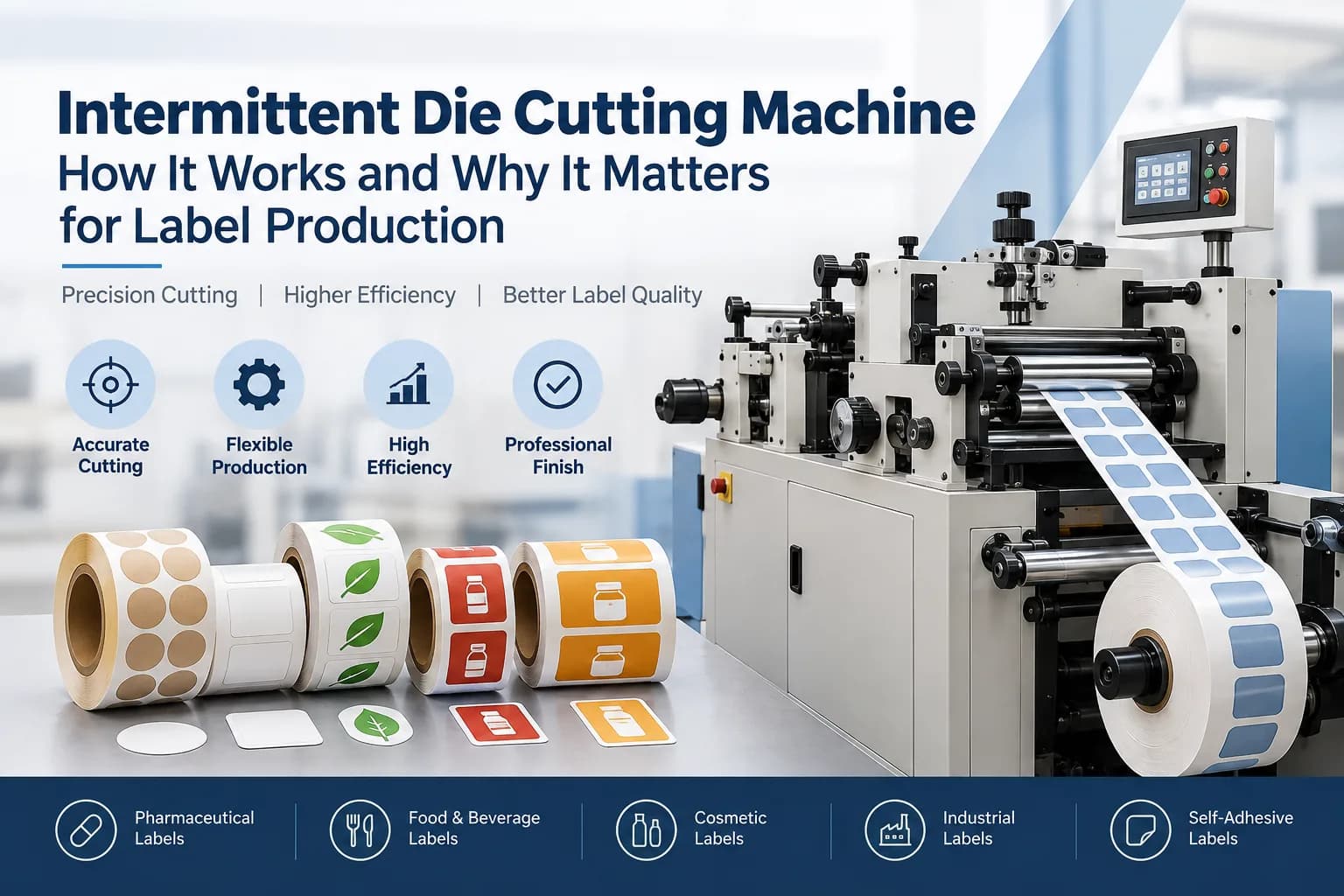
Label production requires more than good printing. The final label must have clean edges, accurate shapes, consistent dimensions, and reliable finishing. This is where an intermittent die cutting machine plays an important role.
An intermittent die cutting system cuts labels at controlled intervals according to the required repeat length. It can support both printed and plain label applications and helps manufacturers produce consistent labels at commercial production volumes.
For businesses looking to improve label converting efficiency, understanding how intermittent die cutting works can help them choose the right equipment and production setup.
What Is an Intermittent Die Cutting Machine?
An intermittent die cutting machine is a label converting machine that cuts printed or unprinted label material into specific shapes and sizes. Instead of continuously cutting the web at the same point, the machine controls the material feed and cutting action according to the selected job settings.
The process allows manufacturers to produce different label formats while maintaining accurate registration and repeat lengths.
For example, the RK Intermittent Half-Full Cut machine supports a die-cutting repeat length from 25 mm to 250 mm and a maximum paper width of 320 mm. It also supports both full cutting and half cutting.
How Does an Intermittent Die Cutting Machine Work?
The basic process follows several controlled stages.
1. Material Unwinding
The label roll enters the machine through the unwinding unit. Controlled tension helps keep the web stable while it moves through the converting process.
The RK system uses a 3-inch airshaft and supports a maximum unwind roll diameter of 550 mm.
2. Web Guiding and Feeding
The machine guides the label material through the cutting section. Electronic web guiding helps maintain proper material movement.
Servo motor control can also provide accurate material feeding. In the RK Intermittent Half-Full Cut, electronic servo control manages the paper-pulling system.
3. Registration and Re-Pass Scanning
Printed labels need accurate registration between the printed artwork and the cutting position. A re-pass scanner can detect the print mark and help the machine align the cutting process with the printed design.
This feature becomes particularly useful when converting pre-printed label stock.
4. Die Cutting
The die-cutting module shapes the label according to the selected die and repeat length.
Depending on the production requirement, manufacturers can use half cutting or full cutting. Half cutting cuts through the label material while leaving the liner intact, while full cutting separates the complete label or label stack according to the machine configuration.
5. Waste Matrix Rewinding
After die cutting, unwanted matrix material can be removed from the label web. An online waste matrix rewinding system collects this waste and helps maintain a cleaner converting process.
6. Rewinding and Collection
The finished labels move toward the rewinding or collection section. Automatic rewinding helps prepare the finished rolls for the next production or packaging stage.
Why Does Intermittent Die Cutting Matter for Label Production?
An intermittent die cutting machine can help manufacturers improve several parts of their workflow.
Better Cutting Accuracy
Accurate feeding, registration and die positioning help create consistent label shapes. This matters when customers require precise branding, product information and packaging presentation.
Flexible Label Production
Different products often need different label sizes and shapes. A machine with adjustable repeat lengths can support multiple label formats without requiring a completely different production system.
Full and Half Cutting Options
Full and half cutting provide flexibility for different label applications. Manufacturers can select the cutting method based on whether they need individual cut pieces or labels that remain attached to the liner.
Improved Production Control
Digital controls and servo systems can make machine setup easier and provide better control over feeding and cutting parameters.
The RK Intermittent Half-Full Cut includes a 7-inch touch HMI and fully digital electronic servo control. Its listed operating speed ranges from 100 to 150 strokes per minute, depending on the cutting length.
Automatic Die Cutting Machine vs Manual Die Cutting Machine
Businesses often compare a die cutting machine automatic setup with a manual die cutting machine.
A manual machine may suit small operations, basic jobs or businesses with limited production requirements. However, operators need to manage more steps manually, which can affect production consistency and throughput.
An automatic system can control feeding, cutting, registration and rewinding with less manual intervention. This makes automation more suitable for businesses handling repeat orders, larger production volumes and tighter production schedules.
The right choice depends on label volume, material, required accuracy, available workforce, budget and production goals.
What Applications Use Intermittent Die Cutting?
Intermittent die cutting can support a wide range of self-adhesive and printed label applications.
Common sectors include:
- Pharmaceutical labels
- Food and beverage labels
- Cosmetic labels
- Industrial labels
- Product stickers
- Self-adhesive labels
- Paper and film-based labels
RK Label Machines lists materials such as paper, PVC, BOPP, PET and self-adhesive label stock among suitable applications for its Intermittent Half-Full Cut machine.
How to Choose an Intermittent Die Cutting Machine
Before purchasing a machine, evaluate:
- Maximum web width
- Minimum and maximum repeat length
- Required production speed
- Full and half cutting capability
- Print registration system
- Servo control
- Waste matrix handling
- Rewinding capacity
- Supported label materials
- Operator controls
- Service and maintenance support
Do not choose a machine based only on its maximum speed. Match the machine configuration with your actual label sizes, substrates, production volume and quality requirements.
Conclusion
An intermittent Hydraulic Die Cutting Machine connects printing and finishing by converting printed label webs into accurate, usable label shapes. Its controlled feeding, registration, die cutting and rewinding functions can help label manufacturers improve consistency and production efficiency.
For businesses comparing an automatic system with a manual die cutting machine, the best choice depends on production volume, label specifications, material requirements and long-term operating goals. A machine should support today's workload while also providing enough flexibility for future label production needs.
Request a customized machine quotation today.
Phone: +91 99789 43687
Email: info@rklabelmachines.com