Choosing the right industrial machine can help manufacturers improve production, maintain consistent quality, and manage operating costs. For businesses that work with labels, films, and packaging materials, precision cutting plays an important role in daily operations.
An induction wad punching machine is a specialized term used in packaging and converting operations, although machine designs vary by manufacturer. The RK HSC-450 model listed by RK Label Machines uses a heavy-duty die-cutting system to process roll-fed materials with controlled feeding, cutting, and waste handling. Understanding its working process, features, and applications can help buyers decide whether this equipment suits their production needs.
What Is an Induction Wad Punching Machine?
A wad punching machine uses a cutting tool and die to cut material into defined shapes or sizes. Depending on its configuration, the machine can process suitable roll-fed materials and support high-volume converting operations.
In packaging production, the term wad often refers to a liner placed inside a bottle cap or closure. Manufacturers may punch these liners from laminated materials that contain foil, paperboard, foam, or polymer layers. However, buyers should distinguish between liner punching equipment and a machine designed for label converting. The correct choice depends on the finished product and the machine's actual capabilities.
RK Label Machines lists the RK HSC-450 with a heavy-duty die-cutting system for roll-fed production. Buyers should confirm the exact application and material compatibility with the manufacturer before placing an order.
How Does an Induction Wad Punching Machine Work?
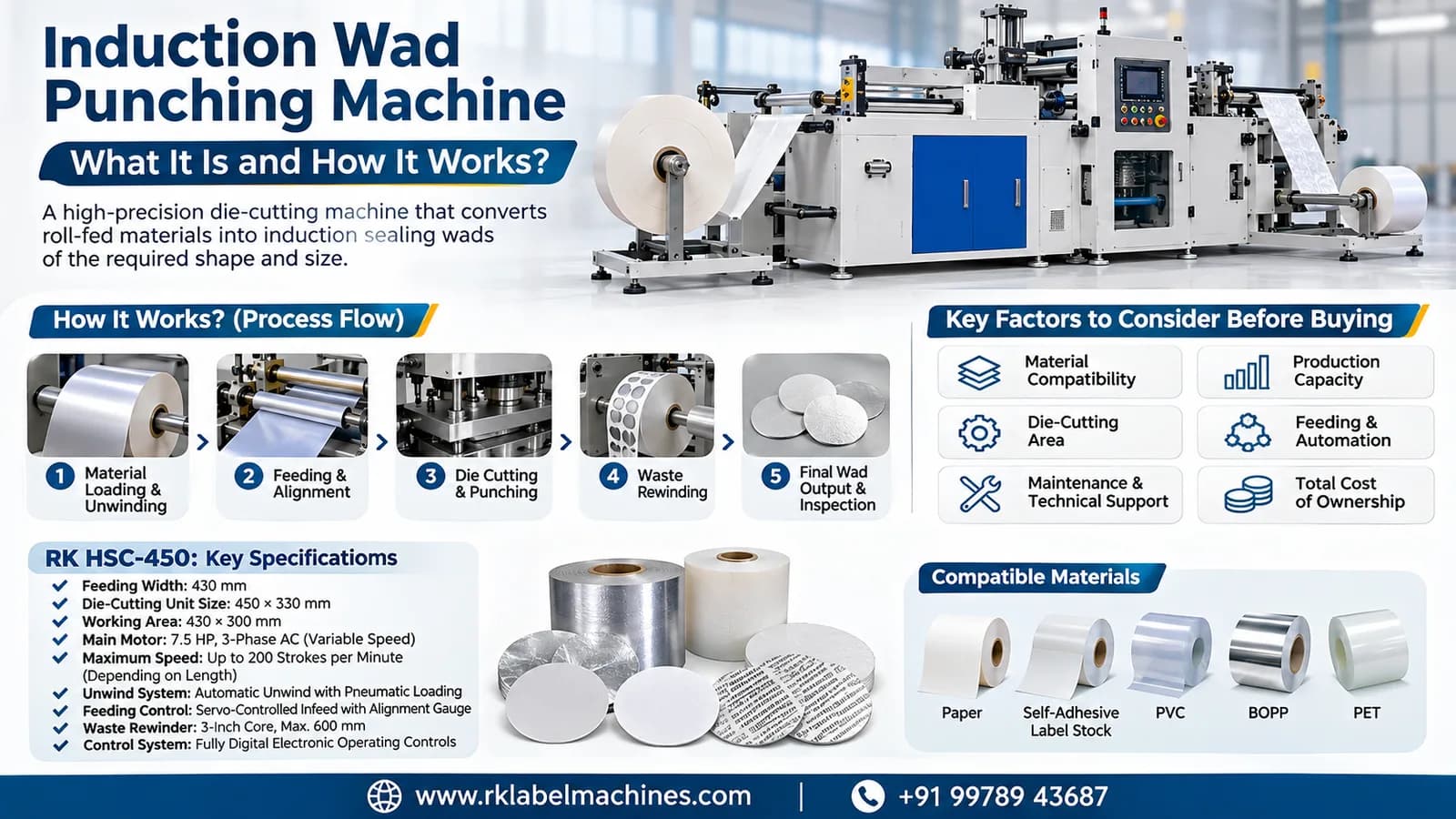
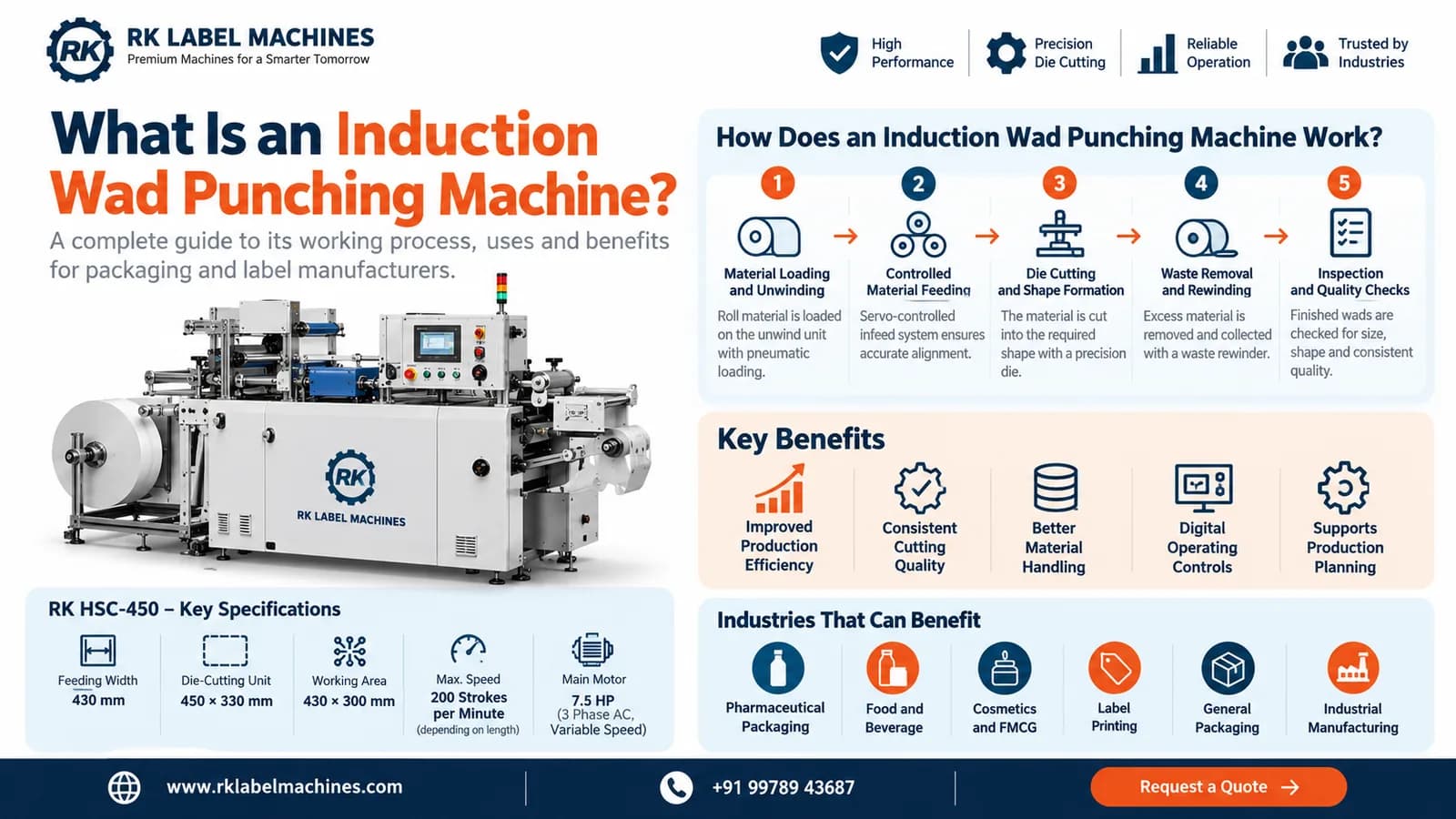
The basic die-cutting process involves feeding material through the machine, aligning it, cutting the required shape, and managing the remaining waste. The exact sequence depends on the machine design.
1. Material Loading and Unwinding
The operator loads a roll of suitable material onto the unwind unit. An automatic unwind system with pneumatic loading helps manage roll handling during production.
Correct loading matters because uneven tension or poor alignment can affect cutting accuracy and create material waste.
2. Controlled Material Feeding
Feed rollers move the material towards the cutting section. A servo-controlled infeed system helps regulate material movement, while alignment controls support consistent positioning.
The operator should select appropriate settings for the material thickness, roll characteristics, and production requirements.
3. Die Cutting and Shape Formation
The material moves into the die-cutting section, where the cutting tool produces the required shape. The die design, material structure, and machine settings influence the finished result.
Before production begins, the team should check the cutting dimensions, edge quality, and compatibility between the die and the substrate.
4. Waste Removal and Rewinding
After cutting, the machine separates or manages the remaining waste material according to its configuration. A waste rewinder can collect suitable waste in a roll, helping maintain a cleaner production area.
Operators should inspect the waste path regularly to prevent material buildup and interruptions.
5. Inspection and Quality Checks
The finished material requires inspection for shape accuracy, clean edges, alignment, and consistency. Manufacturers should establish quality checks that match their product specifications and customer requirements.
Key Features of the RK HSC-450 Die-Cutting Machine
According to the RK Label Machines product page, the listed model includes the following specifications:
- Model: RK HSC-450 with Heavy Duty Die Cutting Machine
- Feeding width: 430 mm
- Die-cutting unit size: 450 × 330 mm
- Working area: 430 × 300 mm
- Maximum listed speed: 200 strokes per minute, depending on length
- Main motor: 7.5 HP, three-phase AC motor with variable speed control
- Feeding system: Automatic unwind with pneumatic loading and servo-controlled infeed
- Control system: Digital electronic operating controls
- Waste handling: Waste rewinder with a listed maximum roll diameter of 600 mm
These specifications provide a useful starting point for evaluating the equipment. Actual output depends on the material, cutting pattern, die configuration, setup time, and operating conditions. A maximum stroke rate does not automatically equal the same number of finished pieces per minute.
What Are the Main Benefits of Industrial Die Cutting?
Improved Production Efficiency
A controlled feeding and cutting process can help manufacturers handle repeat production jobs more efficiently than manual cutting methods. The actual improvement depends on the existing workflow and the product design.
Consistent Cutting Quality
A suitable die and stable material alignment help produce repeatable shapes. Consistent output can reduce rework when operators maintain the correct settings and inspect finished products.
Better Material Handling
Automatic unwinding, controlled feeding, and waste rewinding can simplify roll handling. These features may also help reduce interruptions caused by poor material movement.
Digital Operating Controls
Digital controls support machine operation and setting adjustments. Buyers should ask for a demonstration to understand the available controls, setup process, and operator training requirements.
Support for Production Planning
Manufacturers can compare the machine's working area, feeding width, and rated speed with their expected order volume. This helps them assess whether the equipment fits their current needs and planned production growth.
Which Industries Can Benefit from Die-Cutting Machines?
Industrial die-cutting equipment serves different converting and manufacturing applications, depending on its tooling and material compatibility.
- Label printing: Cutting suitable label stock into the required shapes and formats.
- Packaging: Processing compatible film and laminate materials used in packaging production.
- Pharmaceutical packaging: Supporting suitable label and packaging-component production.
- Food and beverage: Converting compatible materials used in packaging applications.
- Cosmetics and FMCG: Producing labels and other components for consumer products.
- Industrial manufacturing: Processing specified materials for specialized converting requirements.
These applications do not mean every machine supports every material or finished product. Buyers should confirm compatibility with the manufacturer before selecting a machine for a particular production line.
How to Choose the Right Machine for Your Business
Before investing in a machine, review these essential factors.
Check Material Compatibility
Share the material type, thickness, roll width, laminate structure, and finished-product dimensions with the supplier. Ask for a trial using your actual material whenever possible.
Evaluate Production Capacity
Estimate your daily or monthly production target. Consider setup time, changeovers, inspection, downtime, and the number of finished pieces produced per cutting cycle.
Review Tooling Requirements
Ask about die availability, cutting tolerances, tooling life, replacement costs, and the time required to change dies between jobs.
Consider Installation and Support
Confirm the machine footprint, power requirements, operator clearance, installation arrangements, spare parts availability, and after-sales support.
Request a Customized Quote
Provide your application details and production requirements to receive a more relevant proposal. Compare machine capabilities and total operating requirements instead of choosing on purchase price alone.
Conclusion
The right die-cutting equipment can help manufacturers improve material handling, maintain consistent cutting quality, and plan production more effectively. Before purchasing, evaluate your application, material specifications, target output, and tooling requirements rather than relying on rated speed alone. If you are looking for an Induction Wad Punching Machine Manufacturer in India, contact RK Label Machines to discuss your requirements, confirm the suitable machine configuration, and request a customized quotation. Visit RK Label Machinary Private Limited or call +91 99789 43687 to speak with the team.